

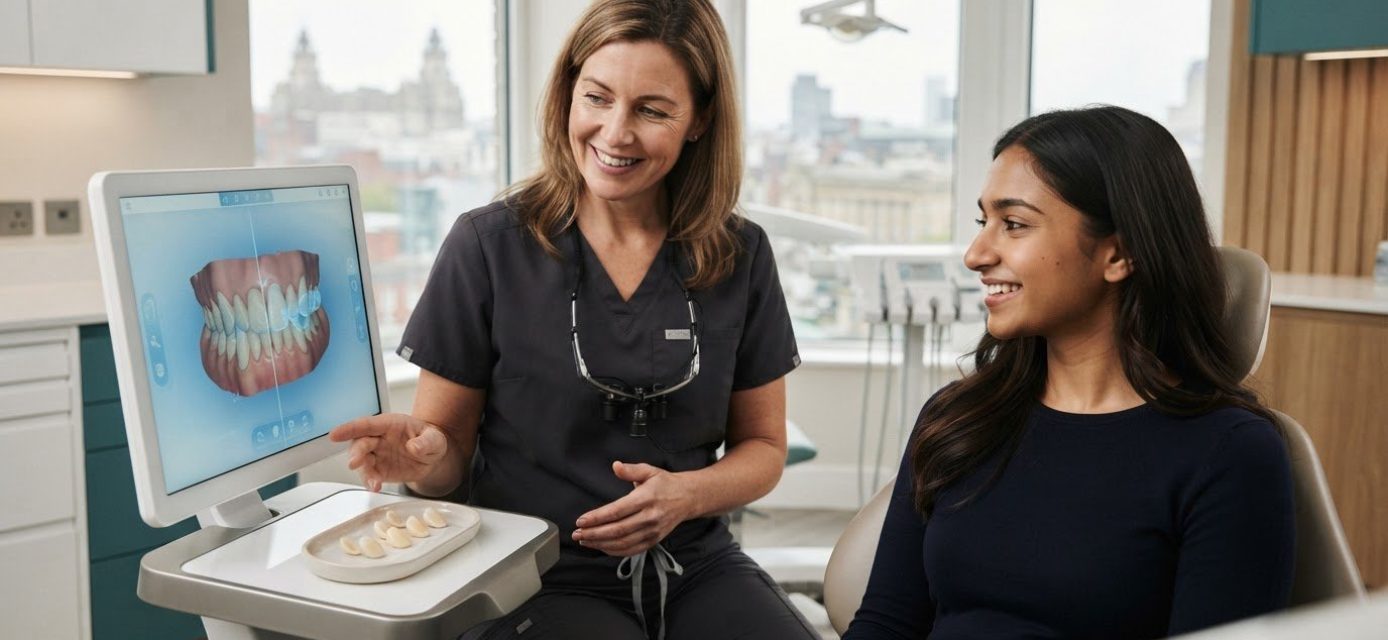
The surprising thing about 3D veneers vs porcelain veneers is that they may not be competing options at all: “3D” can describe how a veneer is designed or made, while “porcelain” describes its material. Knowing the difference helps you ask more useful questions about the proposed treatment and what may suit your smile.
If you’ve seen the terms used as though they refer to two entirely separate materials, the confusion is understandable. “3D veneers” isn’t a standardised clinical term, so the details behind the label matter: material, design, tooth preparation, appearance, maintenance and expected longevity all deserve individual consideration. A name alone can’t tell you whether a treatment is suitable.
At Khan Dental in Liverpool, Dr Khan offers both 3D veneers and porcelain veneers as part of bespoke smile makeovers. This guide explains how material differs from design or manufacturing method, what you can and can’t infer from each term, and what to establish before deciding. It also covers the treatment journey and questions to discuss in an individual assessment, so you can weigh your teeth, goals and clinical needs together.
Veneer terminology can make a considered choice feel more complicated than it needs to be. Separate two questions: what is the veneer made from, and how is it designed or produced? A veneer covers the visible surface of a tooth to change its appearance. For a neutral overview of the basics, see Veneer (dentistry).
In brief: “porcelain” describes a material; “3D” may describe a digital design or manufacturing method. These terms aren’t necessarily alternatives. A digital workflow doesn’t, by itself, tell you the finished veneer’s material. Likewise, knowing the material doesn’t explain how the restoration was planned or made.
“3D veneers” is used inconsistently, rather than as one universally defined clinical category. The phrase may refer to digital steps in a veneer workflow, such as scanning teeth, designing a restoration on screen or using digital information to guide fabrication. The exact process can vary. The label alone doesn’t establish the material, how the veneer will be produced or the treatment protocol.
This distinction helps avoid assumptions. Seeing “3D” in a treatment description doesn’t confirm that a veneer is printed, milled, ceramic or resin-based. Those details belong to the specific treatment plan. For a useful comparison, ask what material is proposed, which parts of the process are digital and how the design relates to your teeth and smile.
Porcelain veneers are restorations made using dental porcelain and planned for the teeth being treated. Their intended appearance depends on more than the material: shape, shade and fit all contribute to how the veneers sit within an overall smile design. A general description can’t determine suitability for an individual, so the treatment details need to be considered alongside your teeth and aims.
If you’d like to explore the material and bespoke planning in more detail, read the porcelain veneers guide. For 3D veneers vs porcelain veneers, the useful questions are what the proposed veneer is made from, how its design will be created and how those choices fit your clinical needs and aesthetic aims.
The route from first conversation to finished veneers should be guided by your dental health and the change you hope to achieve. A digital workflow may affect how information is captured or a restoration is designed, but it doesn’t determine how much tooth preparation is needed. That depends on the clinical assessment and the proposed treatment.
Planning starts with your aims, the condition of your teeth and how your bite functions. Your dentist can then discuss whether veneers are suitable and which approach may fit your needs. Scans or other digital records may support assessment and design when they are part of the workflow, but they don’t replace clinical judgement. The American Dental Association’s overview of porcelain and composite veneers provides further general context about treatment and what to expect.
A considered plan should explain what the proposed design is intended to change and which alternatives may be appropriate. Ask how the material and design process relate to your teeth. Don’t assume that “3D veneers” means you’ll see a digital preview or have a particular number of appointments. Those details depend on the treatment plan and workflow.
The steps may include assessment, planning, preparing the teeth if needed, fitting the restorations and reviewing how they feel and function. The order and number of appointments can vary. Digital tools may shape how design information is handled, while material and fabrication method are separate considerations. The label alone doesn’t establish the precise process.
Digital design does not, by itself, determine whether veneer treatment is invasive. Preparation is a clinical decision based on factors such as the tooth’s condition and the proposed restoration. Discuss whether preparation is suitable, what it involves and why it is proposed before treatment proceeds. No single preparation approach can be assumed for every case.
Before deciding, make sure you understand each stage and have had the chance to raise concerns about comfort or preparation. If you’re considering 3D veneers vs porcelain veneers, an individual smile-design discussion can put the terminology into context. Explore bespoke veneer planning with Khan Dental.
A useful comparison looks past the label and at what is planned for your teeth. “3D” may describe aspects of design or production, whereas “porcelain” identifies a material. Since the terms describe different things, they don’t automatically represent two directly comparable options. Use the details in the treatment plan to compare them.
| Consideration | 3D veneers | Porcelain veneers |
|---|---|---|
| Material | The name alone doesn’t identify the material. It should be clear in your proposed treatment plan. | Made using dental porcelain, with the specific restoration planned for the individual case. |
| Design process | “3D” may refer to digital design or other digital steps. The exact workflow can vary. | Porcelain describes the material, not whether digital tools or other methods are used to plan the restoration. |
| Appearance | The intended result depends on the material, design and how the veneer relates to your teeth. | Shape, shade and fit are considered as part of the intended smile design. |
| Treatment | The label doesn’t establish preparation, appointment sequence or fitting approach. | These details also depend on clinical assessment and the individual treatment plan. |
| Maintenance and cost | Discuss care, possible repairs and the overall cost in relation to the proposed restoration. | Discuss the same practical considerations for the specific porcelain veneers being considered. |
Your priorities can help shape the discussion. You may want to refine tooth shape, address visible imperfections or explore how light and shade contribute to a natural-looking result. Those aims don’t automatically point to one label. Suitability depends on your tooth condition, bite, the change you want and the proposed restoration. An assessment brings these factors together rather than treating a preferred appearance as a decision on its own.
Cost can also be part of your choice. Discuss the cost of the proposed treatment and what it covers, alongside the material, design and care requirements. Comparing prices without those details may not give you a like-for-like comparison.
Evidence about a material and evidence about a digital workflow answer different questions. Findings about porcelain shouldn’t automatically be applied to every restoration described as “3D”; equally, digital design doesn’t establish a veneer’s lifespan. Longevity and outcome depend on the restoration, clinical factors and individual care. Treat general claims as context, not as a personal prediction.
Veneers still need routine oral hygiene and dental reviews. Ask what care is advised for your planned restoration and how damage, repair or replacement would be assessed. The answer depends on the veneer and your clinical circumstances. In the end, 3D veneers vs porcelain veneers is best considered through the details of your treatment plan, not a universal ranking.
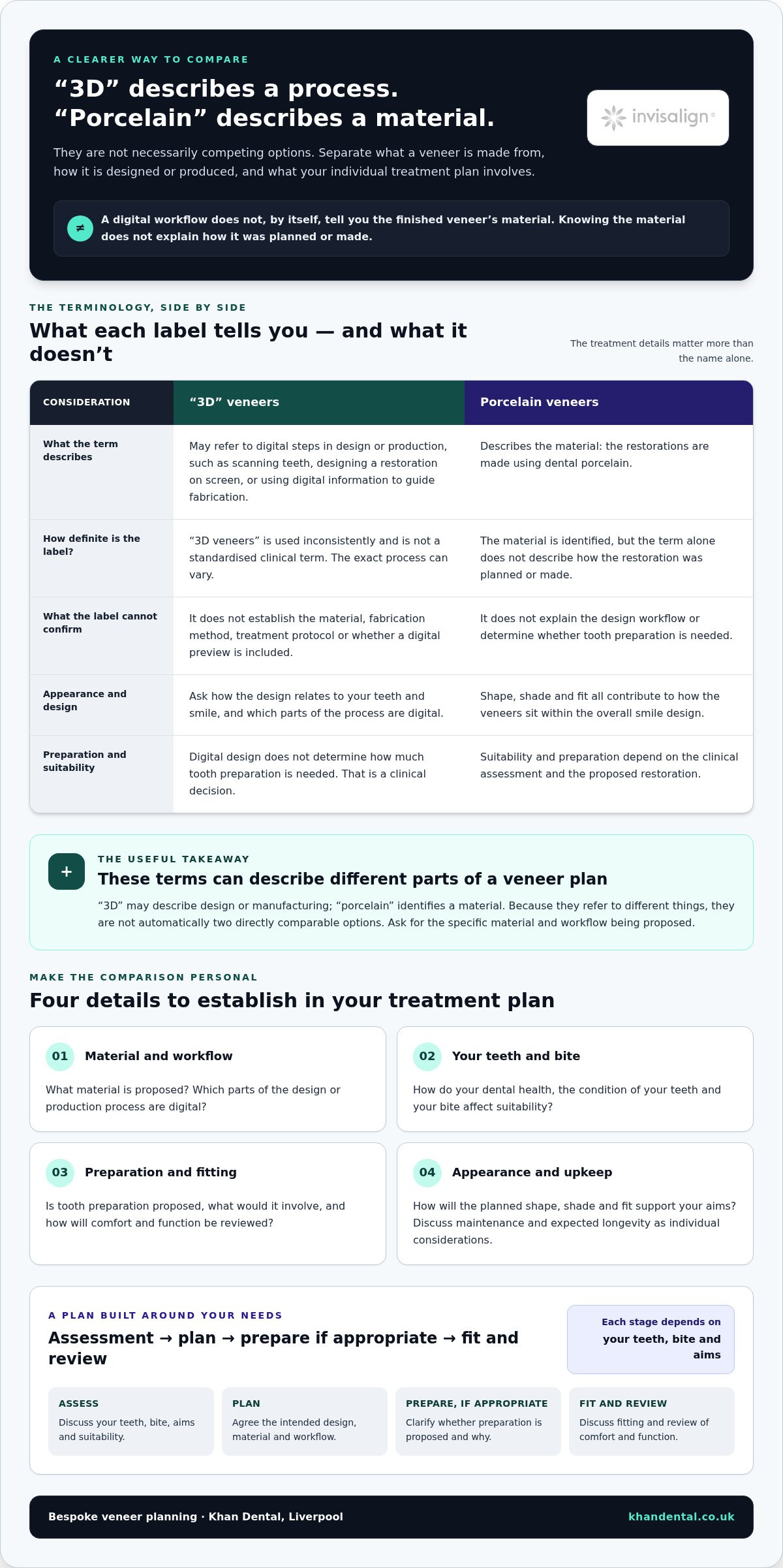
A search can explain terminology, but it can’t show whether veneers are suitable for your teeth. That requires an examination and a conversation about your priorities, dental health and bite. Use this checklist to prepare questions, rather than to diagnose or choose a treatment from a label alone.
Useful questions include: “What change is realistic for my teeth?”, “What material and process are proposed?” and “What would treatment involve in my case?” If you’re anxious about preparation or unsure which details matter most, raise that too. A clear discussion gives you the chance to understand the options before making a decision.
If the examination suggests a different type of restoration may be more relevant, it can help to understand how crowns and veneers differ. Khan Dental’s dental crowns versus veneers comparison offers further context.
Yes. Composite bonding is a separate treatment, not another name for 3D veneers. It may be discussed where appropriate, depending on your teeth and the change being considered. You can read more in the composite bonding guide.
Different concerns may call for different conversations. Teeth whitening may be relevant if your main aim is to change tooth shade, whilst orthodontic treatment such as Invisalign may be considered when tooth position is part of the concern. An assessment helps determine whether these treatments or veneers are suitable for your circumstances.
For a considered decision about 3D veneers vs porcelain veneers, focus on the proposed material, your clinical needs and the treatment plan, not a search-result ranking. Explore veneer options with Khan Dental.
Choosing between veneer options is a personal smile-design decision, not a choice to make from a label alone. At Khan Dental in Liverpool, Dr Khan offers both 3D veneers and porcelain veneers as part of bespoke cosmetic smile care. A consultation gives you the opportunity to discuss what you hope to change and how different possibilities relate to your teeth.
The discussion can start with your priorities, then consider your oral health, tooth condition and bite. From there, you can talk through whether veneers may be suitable and which treatment pathways might address your aims. A personalised plan should explain the proposed material and process, along with relevant preparation and care considerations, so you understand what is being suggested and why.
If terms such as “3D” have left you uncertain, ask what the term means for the option being discussed. This is more useful than assuming it identifies a material or manufacturing method. You can also raise questions about comfort, preparation and the expected appearance. You don’t need to arrive with all the answers.
Preparing a few notes can help you make the most of your appointment. Consider writing down:
Discuss realistic expectations as well. Your aims matter, but the options need to be considered alongside your dental health and what is clinically suitable. A clear explanation can help you weigh those factors without feeling rushed into a particular choice.
Khan Dental welcomes patients considering cosmetic treatment from Liverpool, the Wirral, Manchester, Altrincham, Wilmslow, Knutsford, Hale, Southport, Ormskirk and Formby. You can discuss 3D veneers, porcelain veneers and a plan tailored to your smile, with time to ask questions before deciding how to proceed.
Discuss your smile goals with Khan Dental.
The key to understanding 3D veneers vs porcelain veneers is to look beyond the names. “Porcelain” describes a material, while “3D” may refer to elements of design or manufacture, so the label alone doesn’t reveal the full treatment. Your tooth health, bite, aesthetic aims and proposed plan all matter when considering suitability, preparation and ongoing care.
At Khan Dental in Liverpool, Dr Khan offers both 3D veneers and porcelain veneers as part of bespoke cosmetic smile makeovers. A conversation can help you clarify what you hope to change, explore the options and raise questions, without needing to decide in advance.
To take the next step, arrange a conversation about your smile goals with Khan Dental.
The main distinction is that “porcelain” names a material, whilst “3D” may describe a design or manufacturing process. The phrase “3D veneers” is used inconsistently, so it doesn’t identify one standard material or treatment method. In a 3D veneers vs porcelain veneers comparison, establish what material is proposed and how the veneer will be planned and made, rather than relying on the label alone.
They may be, but the term “3D veneers” alone doesn’t confirm the material. “3D” can refer to digital steps in planning or production, and workflows can differ. Porcelain veneers, by contrast, are made using dental porcelain. Before deciding, ask what material is proposed for your treatment and how the design and fabrication process relates to it. That makes the comparison clearer and more relevant to your case.
You can’t determine durability from the “3D” label alone, because it doesn’t specify the material or workflow. Longevity depends on the restoration and individual clinical factors, including tooth condition, bite and care. Rather than assume one category lasts longer, discuss the proposed material, the evidence relevant to that restoration and how to look after it. Your dentist can explain what those factors may mean for your treatment plan.
Neither label guarantees a more natural-looking result. Appearance depends on the material, planned shape and shade, fit, and how the restoration complements your teeth and smile. “3D” describes neither a particular appearance nor, by itself, a specific material. Discuss the change you hope to see and how the proposed design will address it. Your dentist can assess what may be suitable for your teeth.
Not necessarily. A digital design or manufacturing process doesn’t, by itself, determine how much tooth preparation is needed. Preparation depends on your tooth condition, bite and the restoration being planned. Ask whether preparation is proposed in your case, what it involves and why it may be recommended. If preserving tooth structure is a concern, raise it during the consultation so it can be considered alongside suitability and your aesthetic aims.
Veneers may sometimes be replaced, but removal and what happens afterwards depend on the restoration and the condition of the tooth. If tooth structure has been altered during preparation, removing a veneer may not return the tooth to its original state, and further treatment may be needed. Don’t assume veneers are temporary or freely reversible. Ask your dentist about preparation, future replacement and the care your proposed restorations may require.
Suitability can only be assessed by considering your teeth, oral health, bite and the change you want to achieve. A consultation can clarify the proposed material, design process, preparation and maintenance, so you can weigh the options with relevant information. Khan Dental in Liverpool offers both 3D veneers and porcelain veneers as part of bespoke smile care, led by Dr Khan, a cosmetic and restorative dentist. Bring your questions and priorities to discuss.
Back to Blogs

Schedule a consultation to begin your smile transformation. Our team will assess your needs and create a personalised plan just for you.
Call Us 0151 724 1888
Book a Consultation


