

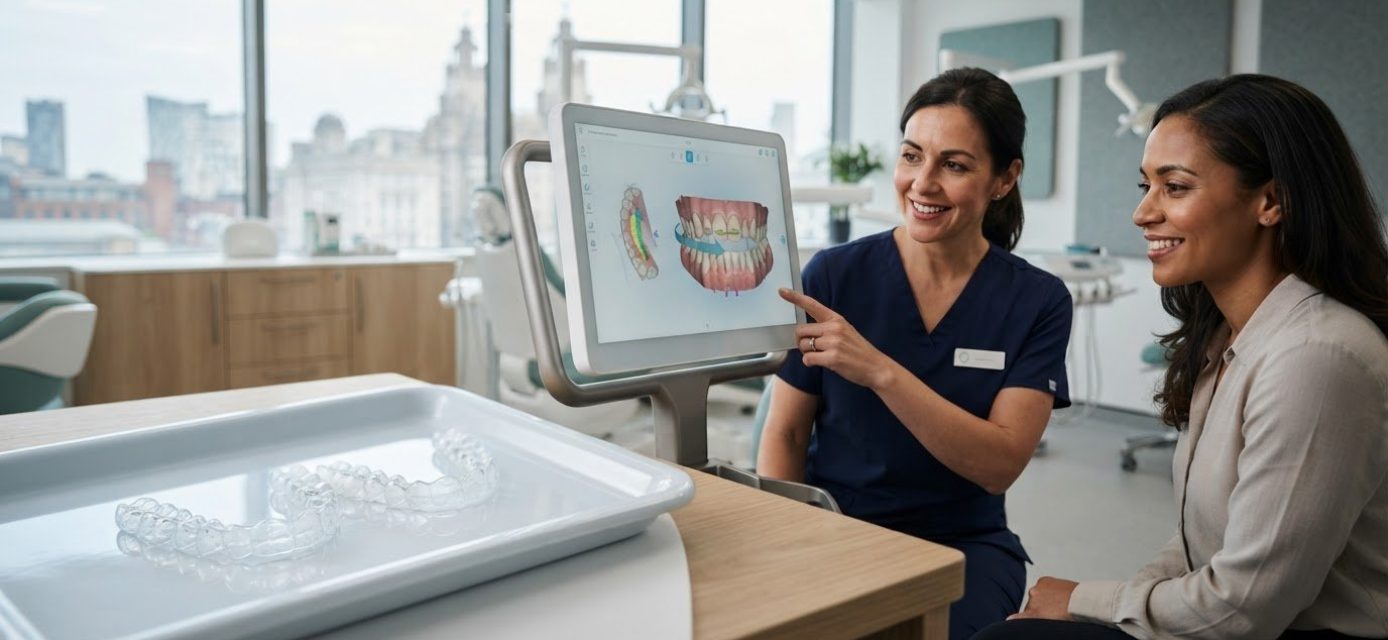
The most recognisable aligner isn’t automatically the right one for your smile. If you’re asking, “is ClearCorrect as good as Invisalign?”, it’s understandable to wonder whether choosing the less familiar name could mean compromising on comfort or results. There isn’t a simple yes or no: the right option depends on your teeth, your bite and the treatment plan.
This comparison explains how the two systems differ, what those differences may mean for comfort and treatment, and why case complexity matters more than brand recognition alone. It also looks at practical factors to consider, including consistent wear and maintaining your smile afterwards. At Khan Dental in Liverpool, Invisalign treatment is planned around your teeth and smile goals. You’ll come away with a clearer understanding of the options and what to discuss when choosing a discreet path towards a smile that feels naturally yours.
Both ClearCorrect and Invisalign are designed to move teeth gradually with a series of custom-made, removable aligners. The aim is a more discreet route to orthodontic correction, without the visible brackets and wires associated with traditional braces. For a neutral introduction to the approach, Clear aligners explains how these appliances guide tooth movement over time.
So, is ClearCorrect as good as Invisalign? Both systems can be effective, but there isn’t one answer for every smile. Your dental anatomy, the movements required and the result you hope to achieve all matter. A straightforward alignment may call for different planning from a case involving complex tooth positions or bite changes. The aligner is a tool; the treatment plan and the clinician’s judgement shape how that tool is used.
Invisalign is the longer-established name, with a substantial history of clinical use. ClearCorrect, part of the Straumann Group, is another established system and may appeal to patients seeking an alternative approach. Rather than assuming one brand is inherently superior, consider what each system offers and how your individual needs guide the decision.
Invisalign has treated more than 17 million patients worldwide, according to figures reported as of April 2026. Its history has also produced extensive treatment-planning experience, while digital tools such as ClinCheck help clinicians map proposed tooth movements and visualise a potential outcome. That established ecosystem is one reason Invisalign is widely recognised by patients and dental professionals.
A digital preview can make the process feel clearer, particularly if you’re anxious about how your smile may change. It is a planning tool, not a guarantee that every detail will unfold exactly as shown. Careful assessment and clinical oversight remain essential.
ClearCorrect offers another professionally planned aligner system, supported by Straumann Group’s dental expertise. Its digital planning platform gives clinicians a way to develop and review treatment plans, while its different treatment options can be matched to the case. Its growing presence gives patients another recognised name to consider alongside Invisalign.
For a patient seeking measured alignment, ClearCorrect may be suitable if its capabilities align with their clinical needs. The deciding factor isn’t simply which system sounds more advanced, but whether the proposed movements, oversight and aesthetic goals suit that person. Khan Dental provides Invisalign treatment in Liverpool, with planning shaped around each patient’s teeth and smile goals.
The aligner’s material and the way its edge sits against your gumline can shape your everyday experience. These are subtle differences, but they matter when you’ll be wearing trays for much of the day and want them to feel as unobtrusive as possible.
Invisalign uses SmartTrack, a proprietary thermoplastic material designed to be flexible and apply controlled force as teeth move. ClearCorrect uses ClearQuartz, a tri-layer material with resilient outer layers and an elastic inner layer. The construction differs, but material alone can’t tell you which system will feel more comfortable: fit, treatment design and individual sensitivity all play a part. For an overview of how the two brands compare, see this Invisalign and ClearCorrect comparison.
Here’s a detail that’s easy to overlook: the trimline, or the edge of the aligner. Invisalign’s scalloped edge follows the contours of the gumline. ClearCorrect’s higher, flatter edge extends beyond the gum margin. That difference may affect how the plastic appears when you smile, particularly if the edge is visible against your gums. The higher trimline is a design feature, not a guarantee of better comfort or a more attractive result. What suits you depends on your mouth and the movements being planned.
Both aligners are made to be discreet, but neither stays pristine without care. Coffee, tea and other strongly coloured drinks can leave residue or contribute to staining. Follow your clinician’s cleaning guidance, and remove aligners for meals and drinks other than water, as directed in your treatment plan.
A new aligner can feel unfamiliar against your tongue and lips. Some people notice a temporary change in speech, often most apparent with “s” sounds, as the tongue adjusts to the trays. The experience varies, and the material or trimline alone doesn’t determine it. If an edge rubs or feels sharp, raise it with your clinician rather than trimming the aligner yourself.
Both systems are removable, so you can take the trays out for meals and special occasions, then follow your clinician’s instructions for putting them back in. Consistent wear remains important for treatment progress. If you’re wondering is ClearCorrect as good as Invisalign for comfort, consider the fit and your personal response, not just the brand name. Khan Dental provides Invisalign treatment with digital planning tailored to your teeth and smile goals. Read about bespoke Invisalign treatment in Liverpool.
A digital preview can make your future smile feel more tangible, but it’s a treatment plan, not a promise that every tooth will move exactly as predicted. Invisalign’s ClinCheck software supports digital planning, while ClearCorrect uses its own planning platform. In either system, the clinician assesses your teeth and bite, maps the intended movements and monitors how closely your teeth follow the plan.
This matters most when movements are more demanding. Mild crowding may require relatively straightforward alignment; pronounced rotations, severe overcrowding or significant bite correction can call for more complex planning. Invisalign is often favoured for complex cases because of its broader range of attachments and extensive treatment history, but the right approach depends on your individual anatomy and clinical assessment. The expert guidance from orthodontists also underlines why clear aligner treatment should be professionally supervised.
Attachments are small, tooth-coloured shapes bonded to selected teeth. They give an aligner additional contact points to help guide movements such as rotation. Invisalign’s SmartForce features include attachments designed for particular movements. ClearCorrect treatment can also use attachments selected by the clinician as part of the plan; the method and placement are tailored to the teeth being moved. Neither a brand name nor a digital preview can replace sound clinical judgement.
During an Invisalign consultation in Liverpool, your teeth and bite can be assessed to identify the movements needed for a balanced result. This assessment is useful if you’re concerned about a complex case or a previous orthodontic relapse.
Teeth don’t always move precisely as planned. If an aligner no longer fits closely or a tooth appears to be lagging behind, the clinician can review the fit, wear routine and progress, then decide whether the plan needs adjusting or additional aligners are appropriate. Refinements are a possible part of treatment, but their availability and terms depend on the specific treatment plan. They aren’t a guarantee of a particular outcome.
There’s no simple rule that one brand always works faster. Progress depends on the movements required, clinical planning and consistent wear. Aligners generally need to be worn for 20–22 hours a day, removing them for eating, drinking anything other than water and cleaning. If you’re weighing up whether is ClearCorrect as good as Invisalign for your case, focus on the complexity of the movements and the quality of the supervision. Khan Dental provides Invisalign treatment with planning and monitoring shaped around each patient’s needs.

Cost matters, but the lowest initial figure doesn’t automatically represent the best value for your smile. ClearCorrect is often positioned at a lower price point than Invisalign, though your overall treatment cost depends on your individual plan. Factors can include the aligner system, the complexity of the movements, clinical planning and the level of monitoring involved. A lower-priced option shouldn’t be assumed to mean longer treatment or more refinements; those depend on your case, how your teeth respond and how consistently you wear your aligners.
Aligner fees reflect more than the plastic trays. Digital planning, clinical expertise and ongoing supervision are part of the treatment journey, alongside the laboratory work involved in producing custom aligners. Rather than comparing brand names in isolation, look at what your proposed plan includes and how it supports your desired result. At Khan Dental, treatment planning is tailored to each patient in a private clinic setting.
Removable aligners offer flexibility, but they rely on a consistent daily routine. Invisalign and ClearCorrect aligners are generally intended to be worn for 20–22 hours a day, removed for meals and for drinks other than water, and cleaned according to your clinician’s instructions. If you expect to leave them out often, that may disrupt progress. Be realistic about your habits before settling on a treatment plan.
Your end goal matters just as much. A patient seeking modest alignment may have different priorities from someone considering a broader smile transformation. Aligners can form one stage of a carefully planned aesthetic journey, while porcelain veneers in Liverpool may be considered as part of a wider design where appropriate. The sequence and suitability depend on your teeth and clinical assessment.
A bespoke smile makeover may also bring alignment together with teeth whitening or composite bonding, where these fit your goals. Khan Dental offers Same Day Smile transformations as part of its wider focus on aesthetic outcomes, but this shouldn’t be confused with aligner treatment being completed in a day. A smile makeover in Liverpool can bring different treatments together where clinically suitable.
Ultimately, “is ClearCorrect as good as Invisalign?” is best answered in the context of your smile, lifestyle and desired result. Khan Dental provides Invisalign treatment in Liverpool, with options considered in relation to your individual needs.
A clear aligner is a carefully made tool, but it can’t decide what will look balanced on your face or how best to guide your teeth towards that result. Treatment success can’t be reduced to a fixed percentage for the tray and the clinician. What matters is how thoughtfully the plan is designed, how it’s monitored and how well it reflects your individual smile.
At Khan Dental, digital treatment planning supports a bespoke approach to Invisalign. Software such as ClinCheck can help map proposed tooth movements and visualise a potential outcome, but it doesn’t replace clinical judgement or aesthetic sensitivity. The aim isn’t simply to make teeth look straight on screen. It’s to plan a smile that feels harmonious with your features and still looks like you.
Planning begins with understanding your concerns and assessing your teeth, bite and smile. Digital tools can help make that conversation more tangible, while clinical expertise shapes the decisions behind the proposed movements. A natural-looking result depends on more than alignment alone: proportion, the way teeth meet and your personal aesthetic goals all deserve attention. If you feel nervous, a calm discussion can help you understand each stage.
The difference is in the detail. Your plan is considered for your smile, rather than treating a software preview as a one-size-fits-all template. That’s especially valuable if you’re hoping to move beyond “straighter” towards a more complete smile transformation.
With professional care, your treatment is planned and monitored by a clinician who can assess how your teeth are responding and guide you if adjustments are needed. This ongoing oversight offers a more considered alternative to trying to manage tooth movement without individual clinical planning. Your responsibilities matter too: following your wear and care instructions helps keep treatment on course.
For some patients, alignment is one part of a wider aesthetic plan. Once tooth position has been considered, options such as professional teeth whitening or composite bonding may complement the overall result when clinically suitable. The sequence is tailored to your teeth and goals, not a promise of a particular “celebrity” finish.
So, is ClearCorrect as good as Invisalign? The brand matters, but it’s only one part of the decision. Khan Dental provides Invisalign with treatment planning shaped around your teeth, bite and aesthetic goals. The starting point is understanding the smile you’d like to achieve and the approach that best supports it.
So, is ClearCorrect as good as Invisalign? Both can support discreet tooth movement, but the right choice depends on your dental needs, aesthetic goals and the clinician’s treatment planning. Materials and aligner design may influence everyday comfort, while complex movements, consistent wear and ongoing professional guidance all contribute to the treatment journey.
At Khan Dental, a private cosmetic dental clinic in Liverpool, Invisalign treatment is planned around your teeth and smile goals. Careful assessment helps shape a bespoke approach, and a calm, attentive discussion can make each stage feel more considered.
Khan Dental welcomes patients from Liverpool, Wirral, Manchester, Altrincham, Wilmslow, Knutsford, Hale, Southport, Ormskirk and Formby. Book an Invisalign consultation at Khan Dental to discuss your smile and the treatment approach that may suit you.
ClearCorrect may be offered at a lower price than Invisalign, but there isn’t one fixed UK price difference. The fee depends on factors such as the complexity of your case, the treatment plan and the care included. For a fair comparison, look beyond the headline price: consider what clinical planning, monitoring and any planned refinements involve. At a private clinic in Liverpool, your quote should relate to your individual treatment needs.
Both systems can address a range of alignment concerns, but suitability for a complex bite issue depends on your teeth and the movements required. Invisalign is often favoured for more complex cases, including significant bite correction, because of its broader treatment capabilities. That doesn’t mean it’s automatically right for everyone. The question “is ClearCorrect as good as Invisalign” is best answered after a clinician assesses your bite and explains what each approach can achieve for you.
Both are designed to be discreet, and most people will notice your smile more than your aligners. Invisalign has a scalloped edge that follows the gumline, while ClearCorrect has a higher, flatter trimline, which may look different at the gum margin. Visibility can also depend on fit, lighting and how well you care for your trays. Remove aligners for meals and drinks other than water, following your clinician’s instructions, to help keep them clean.
There’s no reliable rule that one brand is more comfortable for everyone. You may feel pressure or temporary tenderness when starting a new set, as the aligners guide your teeth through planned movements. Your individual sensitivity, the fit of the trays and the treatment stage can all affect how they feel. If discomfort is persistent or an aligner seems not to fit properly, speak to your treating clinician rather than adjusting it yourself.
There isn’t one average duration that applies to both systems or every patient. Treatment time depends on the movements needed, how your teeth respond and whether you wear your aligners as instructed. Consistency matters: aligners are generally worn for 20–22 hours a day, with breaks for meals and cleaning. Your clinician can estimate a timescale after assessing your smile, then review progress and adjust the plan if needed.
It may be possible, but switching isn’t as simple as exchanging one tray for another. The new clinician would need to assess your teeth and progress, then decide whether new scans and a revised plan are needed. A change of system could affect your treatment schedule, so don’t stop or change aligners on your own. Discuss your concerns with the clinician overseeing your treatment, who can explain the safest next steps for your case.
Retainers are commonly recommended after orthodontic treatment with either system because teeth can shift after active tooth movement ends. Your clinician will advise what type of retainer suits your result and how often to wear it. Following that guidance is an important part of maintaining your new alignment. If you stop wearing a prescribed retainer, teeth may move, so raise any discomfort or fit concerns early rather than leaving it out indefinitely.
Neither aligner brand can guarantee that teeth will remain perfectly still for life. Long-term stability depends in part on wearing retainers as advised and attending any recommended follow-up care. The treatment system helps guide teeth into position; retention helps maintain that result afterwards. Your clinician can explain what ongoing retainer use may involve for your smile and how to respond if you notice movement. This applies whether your treatment used ClearCorrect or Invisalign.
Back to Blogs

Schedule a consultation to begin your smile transformation. Our team will assess your needs and create a personalised plan just for you.
Call Us 0151 724 1888
Book a Consultation


