


Protecting a newly transformed smile shouldn’t feel like walking on eggshells. Many patients leave the clinic worried that a single misplaced bite or the wrong morning toothpaste might chip or loosen their bespoke restorations. In reality, maintaining porcelain veneers relies far less on fragile caution and far more on informed, daily precision. With clinical studies confirming a 95% success rate at the ten-year mark, these handcrafted ceramics are designed to endure when supported by the right habits.
It’s completely natural to feel protective over your cosmetic investment, particularly when conflicting advice leaves you second-guessing your oral care products or worrying about decay beneath the surface. You deserve total peace of mind every time you eat, brush, or smile with confidence. This guide reveals how to protect your cosmetic investment and keep your porcelain veneers radiant for fifteen to twenty years. Ahead, you’ll discover the simple daily cleaning rituals, safe ingredients, and tailored aftercare essentials that preserve your smile’s luminous aesthetic for decades.
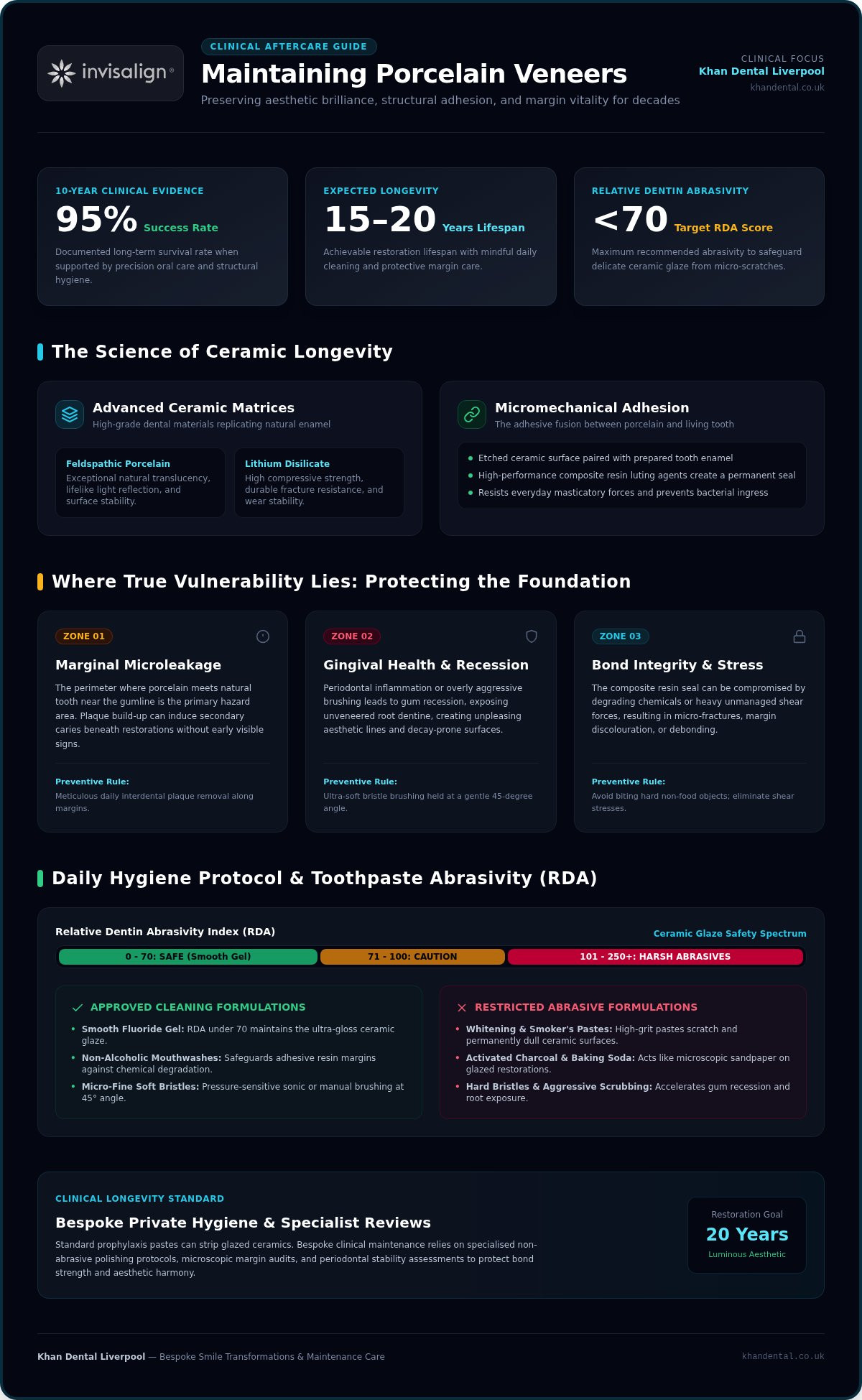
High-grade dental ceramics possess remarkable mechanical resilience. Crafted to replicate the intricate translucency and compressive strength of natural tooth structure, modern veneers resist wear and surface discolouration with exceptional reliability. When considering the art of maintaining porcelain veneers, it helps to understand that their longevity is rarely limited by the ceramic material itself. Instead, long-term success rests upon two foundational pillars: the stability of the adhesive bond and the continued vitality of the living tooth structure beneath.
Modern cosmetic dentistry relies on advanced ceramic matrices, notably feldspathic porcelain and lithium disilicate. These materials mimic natural enamel by allowing light to pass through their surface before reflecting back, ensuring a seamless, lifelike appearance. According to clinical overviews of modern Veneer (dentistry), the bond between ceramic and enamel is achieved through precision micromechanical adhesion. High-performance composite resin luting agents fuse with both the etched porcelain surface and the prepared tooth enamel, creating an exceptionally durable union. You can explore our meticulous clinical technique for porcelain veneers Liverpool transformations to see how this precision craft unfolds in practice.
A common misconception is that a veneered tooth becomes impervious to everyday dental issues. While the ceramic shell cannot develop tooth decay, the natural tooth supporting it remains vulnerable. The critical zone is the margin, the microscopic boundary where the porcelain edge meets the natural tooth near the gumline.
Safeguarding this perimeter is the true secret to maintaining porcelain veneers over fifteen to twenty years:
By protecting the margins and preserving healthy periodontal tissue, you ensure that your veneers remain firmly anchored, pristine, and structurally sound for decades.
Caring for your new smile doesn’t require complex rituals, but it does demand mindful product selection. A common misstep is treating cosmetic restorations with the same abrasive pastes used for natural enamel. Successfully maintaining porcelain veneers means adopting habits that honour the glass-smooth ceramic glaze while keeping the underlying tooth and gum tissues pristine. Understanding the factors that determine your porcelain veneer lifespan begins right at your bathroom sink with the tools you choose each morning.
Most commercial whitening toothpastes contain abrasive particles like baking soda, hydrated silica, or activated charcoal designed to scrub away extrinsic enamel stains. On ceramic surfaces, these abrasives act like microscopic sandpaper, gradually dulling the lustrous factory polish over time. To protect your smile, check the Relative Dentin Abrasivity (RDA) value of your toothpaste:
Plaque collects quickly along the margins where the ceramic meets the natural tooth, making daily interdental cleaning indispensable. Glide traditional floss smoothly down between each contact point, wrap it into a soft C-shape against the tooth wall, and slide it out gently. Never snap floss aggressively upward against the incisal edge, as sharp upward leverage can stress the bonding seam. If traditional string feels awkward, plastic-coated interdental brushes sized to your gaps or a gentle water flosser provide thorough, low-risk cleansing around restorative edges.
The chemical composition of your mouthwash matters just as much as your brushing technique. Steer clear of formulas containing high concentrations of alcohol, as repeated exposure can soften the microscopic composite resin seal that anchors the restoration to your natural tooth. Instead, choose a soothing, alcohol-free therapeutic rinse with neutral sodium fluoride. For the best remineralisation of your natural tooth structure, use mouthwash between meals rather than immediately after brushing so you don’t wash away your toothpaste’s active protection.
If you’re ever uncertain about whether your everyday bathroom products support your restorations, you can consult with the aesthetic team at Khan Dental to build a tailored daily homecare regime designed around your smile.
Living with hand-crafted ceramics doesn’t mean enduring a restrictive diet or missing out on dinner parties. Instead, it invites a subtle shift in awareness. By understanding how mechanical stress and everyday dietary pigments interact with ceramic surfaces, you can easily protect your restorations while enjoying every meal. Successfully maintaining porcelain veneers over decades is less about drastic self-denial and more about mindful daily choices.
High-fired dental ceramic is entirely non-porous and completely impervious to chromogenic staining. Unlike natural enamel, a porcelain restoration will not yellow from exposure to rich espresso, aged red wine, or turmeric. The true area of focus is the microscopic boundary along the gumline, where composite resin secures the ceramic edge to your tooth. Over several years, frequent exposure to deeply pigmented liquids can produce faint discolouration along these delicate seams. Swishing fresh water around your mouth after rich foods easily rinses away tannins before they settle. If you are exploring comprehensive treatment, our bespoke smile makeover Liverpool consultations ensure restorations are planned with stain-resistant margins that blend effortlessly with your natural dentition.
Porcelain exhibits remarkable compressive strength when biting straight down, yet it remains vulnerable to harsh lateral shear stresses. Biting directly into firm, unyielding foods with your front teeth introduces torsional leverage that can dislodge or fracture delicate ceramic edges. Following structured guidelines for daily care for veneers helps you navigate social dining without hesitation:
Involuntary clenching and nocturnal grinding (bruxism) represent the single greatest threat to restorative longevity. During deep sleep, the jaw muscles can generate hundreds of pounds of pressure without your conscious awareness, placing enormous stress on ceramic shells. Without intervention, repeated grinding leads to occlusal wear, micro-cracks, and premature debonding. A tailored, lab-crafted occlusal nightguard solves this problem completely. Fabricated from smooth, resilient polymers, the guard absorbs nocturnal tension and distributes bite forces evenly across the entire arch, giving you complete confidence while you sleep.
Home care establishes the daily groundwork, but specialist clinical oversight ensures that your restorations remain pristine year after year. Even the most meticulous brushing cannot eliminate the calcified tartar that gradually forms along subtle micro-junctions. Regular six-monthly private reviews allow your clinician to inspect adhesive margins, evaluate soft tissue response, and confirm that your bite remains harmonious. Successfully maintaining porcelain veneers over decades requires this collaborative clinical partnership. If you are ever curious about how varying cosmetic solutions distribute functional forces differently across your mouth, take a moment to explore our comparative guide on dental crown vs veneer treatments.
Standard dental cleanings must be thoughtfully adapted when ceramic restorations are present. Traditional metal ultrasonic scalers can micro-chip the margins of porcelain, while coarse pumice pastes quickly strip away the glossy ceramic finish. Your hygiene visits should always follow cosmetic-safe protocols:
Subtle shifts in natural tooth alignment happen gradually over a lifetime. Because of this, Dr. Khan routinely examines your bite using articulating paper during cosmetic review appointments, ensuring that minor jaw movements haven’t introduced unwanted friction points against your veneers. Using high-magnification loupes, we scrutinise every millimetre of the restorative boundary to identify micro-gaps or marginal discolouration long before they become visible to the naked eye. When appropriate, a gentle professional re-polishing with specialised diamond pastes instantly restores that smooth, radiant surface glow.
Whether you received your restorations with us or simply need expert care for an existing smile, book your private veneer maintenance review with Khan Dental to safeguard your cosmetic investment for the years ahead.
A transformative smile makeover is an enduring artistic investment, not a single clinical event. At Khan Dental in Liverpool, we welcome patients from across Merseyside, Wirral, Cheshire, and Manchester who want their restorations to look as breathtaking in fifteen years as they did on day one. Our private practice is crafted as a peaceful sanctuary where clinical precision meets genuine warmth, taking the anxiety out of post-treatment appointments. True confidence in maintaining porcelain veneers comes from knowing you have a dedicated aesthetic team supporting your smile at every stage. For patients seeking subtle adjustments or paired cosmetic treatments, our practice also provides alternatives like composite bonding Liverpool services to achieve harmonious, multi-layered results.
Every aesthetic review at our Liverpool clinic is entirely bespoke. Rather than conducting a rushed check-up, Dr. Khan conducts a thorough examination designed to protect your restorations:
Even with conscientious care, life happens. An unexpected impact or a hidden clenching habit can occasionally challenge a restoration. If you notice a tiny chip, feel a rough contour with your tongue, or suspect a veneer has debonded, stay calm. Never attempt home fixes with household glues or commercial repair kits; these compounds contain harsh chemicals that irreparably damage the underlying natural enamel and ruin the ceramic interface.
Instead, keep the detached ceramic shell safe in a clean container and reach out to our team right away. We will arrange a prompt cosmetic assessment to examine the tooth structure, gently polish minor micro-chips, or cleanly rebond the intact veneer using specialised adhesive resin. To secure the longevity of your handcrafted restorations, Book your consultation with Khan Dental and enjoy the lasting assurance of bespoke cosmetic care.
Achieving decades of natural radiance doesn’t require complicated rituals. By pairing gentle, non-abrasive cleansing with protective nighttime habits, you create the ideal foundation for maintaining porcelain veneers. When supported by routine specialist reviews that safeguard delicate composite margins and periodontal health, your handcrafted restorations can easily preserve their luminous, lifelike aesthetic for up to twenty years.
Led by cosmetic specialist Dr. Khan, our team pairs bespoke smile transformations with comprehensive post-treatment care programmes designed for lifelong durability. From our dedicated private clinic in Liverpool, we welcome patients across Merseyside, Wirral, Cheshire, and Manchester into a calm, unhurried environment focused entirely on your comfort and peace of mind. Your smile is a lasting reflection of your self-assurance. Book your bespoke smile consultation with Khan Dental today, and let us help you safeguard your cosmetic investment with precision, artistry, and genuine care.
No, high-grade dental porcelain is completely non-porous and will not absorb stains from dark beverages. The glazed ceramic surface repels chromogenic pigments found in espresso, red wine, and tea. However, the microscopic composite resin line bonding the veneer to your natural tooth can pick up minor surface discolouration over many years. Rinsing your mouth with plain water after enjoying richly pigmented drinks keeps these delicate margins bright and virtually invisible.
A smooth, non-abrasive fluoride gel with a Relative Dentin Abrasivity (RDA) score under 70 is ideal. For successfully maintaining porcelain veneers, avoid whitening pastes containing baking soda, activated charcoal, or harsh silica particles. These gritty abrasives create microscopic scratches across the ceramic surface, gradually dulling its natural reflective lustre. Look for gentle, daily formulas that strengthen your natural enamel margins without eroding the exquisite factory polish.
Yes, daily interdental flossing is vital to prevent plaque buildup along restorative margins. While the ceramic shell itself cannot rot, food debris and bacteria collect in the tight spaces between teeth. Leaving this area uncleaned invites gingival inflammation and gum recession, exposing underlying natural enamel. Gently glide unwaxed or PTFE tape between teeth and curve it around the gumline, taking care not to snap the floss upward against the edges.
Yes, underlying natural tooth structure remains susceptible to decay if plaque breaches the adhesive margin. Dental porcelain is immune to bacterial caries, but the back of the tooth and the root structure near the gumline are not. If oral hygiene falters, bacteria seep into the micro-junction where ceramic meets enamel, causing hidden decay beneath the restoration. Thorough brushing, daily flossing, and balanced nutrition ensure the supporting tooth stays healthy and structurally sound.
Store the restoration safely in a clean container and contact your private dental clinic right away. Never use domestic adhesives or commercial glue kits to reattach the ceramic, as household chemicals can permanently damage your tooth enamel. At Khan Dental in Liverpool, Dr. Khan can evaluate whether the shell can be safely sterilised and rebonded or if gentle refinishing is needed. Prompt professional care ensures seamless restoration without risking underlying tooth damage.
Yes, electric toothbrushes are safe and highly effective when fitted with soft bristle heads. Modern sonic or oscillating brushes with integrated pressure sensors remove biofilm thoroughly without harming the ceramic glaze. Simply let the vibrating filaments glide gently along your gumline without pressing hard. When maintaining porcelain veneers, avoid stiff-bristled heads and aggressive scrubbing, which can irritate delicate gingival tissue and encourage receding margins over time.
You should attend a specialist cosmetic review and hygiene visit every six months. Regular appointments allow our team in Liverpool to assess marginal integrity, monitor bite alignment, and use cosmetic-safe glycine airflow systems to lift tartar gently. For patients across Merseyside, Manchester, and Cheshire, these dedicated bi-annual checks catch minor bite friction or micro-gaps early, preserving the luminous aesthetic and bond strength of your smile for fifteen to twenty years.
Back to Blogs

Schedule a consultation to begin your smile transformation. Our team will assess your needs and create a personalised plan just for you.
Call Us 0151 724 1888
Book a Consultation


